• Skip to primary navigation
  • Skip to main content
  • Skip to primary sidebar
TheWayoftheWeb

TheWayoftheWeb

Content and Digital Marketing Specialists

  • Blog
  • The Cipher
  • About Us
    • Useful Resources For Businesses In Peterborough, UK
  • Contact Us
  • Show Search
Hide Search

free

Google Apps – no more free sign-ups, no more Freemium

December 8, 2012 By Dan Thornton

Six years ago, Google Apps launched with a great suite of tools which could be used for collaboration and work for free by anyone with less than 10 users. A year later, the paid premium versions became available, and now that’s all that will be available, as Google has now stopped new sign-ups to the free option.

Apparently due to the difficulty of managing the experience for individuals and businesses, the options now are for individuals to use a free personal account, which still gives you access to the likes of Gmail, Google Drive etc, while businesses need to pay $50 per user per year. Existing customers, including those on the free version, will continue as before.

The implications of ending free Google Apps:

I’ve used Google Apps since launch, and maintain a number of different Apps accounts. From a business perspective, we’ve been inching closer to the user threshold to pay anyway, so it was always on my radar, and I have no problem investing in the right tools. No business can rely solely on free tools and services and be able to guarantee reliability, which is why we mix and match to ensure we use the best paid and free options together to do the best job.

Free Parking

But I’ve also recommended Google Apps to a lot of people over the years, and that’s going to have to stop with the loss of the free version, as it rules out a number of use cases.

Easy email addresses: If you own a domain and wanted to have the corresponding email addresses with a very easy set-up, Google Apps was perfect for that. Simpler than editing MX records, and it meant you could quickly use Gmail or other email services without any hassle. But it’s not worthwhile for $50.

Micro businesses: When TheWayoftheWeb started it was just me, and more people have been added rapidly to the team over the last couple of years. As we respond to increased demand, the revenue has covered the need for more admin and collaboration tools, but at the same time, I’ve been experimenting with other projects, like niche publishing, where adding the costs for 4-5 users would wipe out the profits from some sites entirely. The benefits of easy collaboration just aren’t there.

Businesses in developing economies: A cost of $50 per person is relatively low for most people in developed economies. It’s much harder if your income and profits are much lower. In countries where $50 is a substantial proportion of a monthly or annual wage, they’re now effectively stopped from signing up to what is a decent and fairly reliable set of tools.

New experimentation: I love experimenting with new projects and ideas. And while that isn’t going to stop, the free Google Apps option meant that I could quickly set up a workspace for a small team, run an idea for a while, and see whether it’s viable or not. Now new projects will either need to use alternatives, rely on more labour intensive methods, or be reduced to those which realistically cover their costs in a short space of time.

Sad times for Freemium:

The ‘freemium’ model has had some successes and some detractors, since it started to become popular. Offering free access with a further paid version was never guaranteed to deliver the returns for a business, but many people jumped on the bandwagon.

But with a company as big as Google, which apparently made $1 billion from the sale of Google Apps and mapping software to businesses and governments over the past year, dropping the freemium approach for Apps, it sends a pretty big signal to over people using that model.

And personally I think that’s a bad move. I agree with the idea that ‘if you’re not paying for a product, then you are the product’, but I also believe that many products need time and engagement to prove their true value, and the freemium model allows that to happen. I can’t remember how long I used the free versions of Spotify or Flickr for, but it was months and years before I then took the decision to pay for both services, and I’ve remained a customer ever since.

Encouraging people into online collaboration takes time and effort, and having free tools available means you can focus on engaging colleagues without any panic that you need to cover costs immediately. There are several great project management tools, for example, which offer a 30 or 60 day trial – but I’ve often found those trials are too short to get new projects up and running effectively and show any value before the payments kick in and the idea gets ended all too soon.
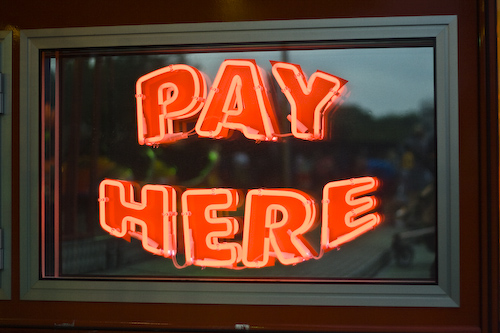
Pay Here

Apparently with more than 5 million businesses on Google Apps, the majority have less than 10 users and are on the free version, so this is the cost Google seeks to remove. But given the 6 year maximum growth available to Google Apps users, I’d question how many businesses have had the time to actually scale from a handful of users to a major business in that time, given the failure rate amongst small businesses around the world.

Damaging to Google’s brand?

I understand the logical business rationale for concentrating on paying users rather than free. It’s a balance I have personal experience of with clients just as Jigoshop, and it can lead to a lot of complex decisions and debates.

But Google seems to be making a lot of decisions which detract from their supposed stance to ‘Do No Evil’ and ‘Organise the world’s information’. Moves like putting all their effort into Google+ at the expense of other services such as Google Reader, dropping Feedburner advertising and setting it up for likely closure, and dropping free tools for collaboration show a company which is far closer to competitors like Apple and Microsoft now than ever before, particularly as Microsoft in particular has moved towards better and cheaper online tools.

In terms of belief, it’s harder than ever to know what Google really stands for, and what they’ll do next. That makes it harder to identify with them as a personal user/consumer, and much harder to include them in business decisions.

Is Open Source the new black?

July 15, 2010 By Dan Thornton

It seems as if Open Source is becoming fashionable, particularly when it comes to maps. In the last 24 hours or so, we’ve had:

  • AOL launching an open source map project
  • Adobe announcing an open-source collaboration with SourceForge
  • Vodafone makes almost all of Wayfinder open source (after paying $30 million for it)

And that’s in addition to the open source newspapers and watches I recently wrote about.

Although I believe open source is a very useful and viable way to work, I do worry about companies leaping into it without some careful planning and research. It almost feels a bit like turning ‘build it and they will come’ into ‘open source it and they will come’.

If you want a great insight into some of the complexity of open source, then Free For All by Peter Wayner is well worth reading (especially as he’s made it avaiable for free in various formats). The fact that it’s almost a decade old means it’s easier to focus on the issues than the technology involved.

Or if you want modern proof, take a look at the current disagreement between WordPress founder Matt Mullenweg and the creator of the Thesis design and framework, Chris Pearson, which may end up in legal action.

Just as Open Source is ‘free as in free speech and not as in free beer’, it also takes as much effort as anything worthwhile – it just does it in different ways…

Saturday link round-up

April 18, 2009 By Dan Thornton

Some interesting links for the weekend:

London’s best free wi-fi hotspots – Timeout: The type of guide I kept meaning to find/write, and suddenly it appears!

Email is such a blunt tool – Neil Perkin: Neil not only writes consistently great posts but always seems to find the perfect images to illustrate them, along with brilliant visual presentations.

Social Media is good for you – Faster Future: Nice post from Dave Cushman as a counterpoint to the shock headline-grabbing about how Facebook/Twitter etc are replacing the other scourges of humanity – the radio, record player, television, video nasties, video games etc. See also my earlier post responding to the social networking health threat…

Gordon Brown is apparently going to protect ‘high quality’ content on the internet – Cnet: For ‘high quality’, assume he means traditional media – and for how he’s going to protect it – he has no idea, or at least he isn’t telling anyone…

Swedish ISP won’t retain user data – Ars Technica: ‘Jon Karlung, the head of ISP Bahnhof, says that his company won’t turn over any user data to authorities because it refuses to keep any log files. That decision is legal—for now’. This is why I love the Swedes so much!

Passion is why Nine Inch Nails and vinyl are succeeding

January 7, 2009 By Dan Thornton

There’s already a lot of commentary on the fact that Nine Inch Nails topped Amazon MP3 Album sales for 2008, despite the fact the first nine tracks of the  album had already been released by the band for free under a Creative Commons licence.

And the fact that vinyl album sales doubled in 2008, hitting a 17 year record of 1.88 million in 2008.

As Matt Mason points out, both examples show that ‘the physical souvenir of a digital idea still has value‘, and legitimate purchasing is becoming easier and more cost effective – for instance, Apple dropping DRM from iTunes and introducing variable pricing (although you’ll have to pay to remove DRM from tracks you already own). Om Malik nicely outlines the reasons why even the bonus from that DRM removal isn’t necessarily a good thing for the music industry – mainly because the three-tiered pricing structure being introduced could lead to more people expecting music for less.

And analysts are backing the idea that mobile music has to be free, for example.

Are there answers?

Going slightly further than Matt, I’d say buying an album already available for free, or investing in vinyl, shows something more than the benefits of better legitimate music stores or physical souvenirs.

I’d say it’s a direct result of passion.

The people most likely to download and spread NiN’s Ghosts I-IV are the passionate fans of the band. The people downloading from Amazon were aware of the album but either didn’t want to make do with the nine free tracks, didn’t want to download directly, or, possibly wanted to spread the word by purchasing via Amazon and propelling NiN up the charts.

Meanwhile to be a vinyl consumer you have to find a record player (hard to do offline outside of specialist hifi shops),  invest in needles and fluff removers, and actively seek out releases.

But what paying for NiN or vinyl does, is it elevates you from those people enjoying music as a diversion or convenient entertainment – it makes you someone who displays there passion for the band or format.

You don’t just like NiN enough to listen or download for free – You love them enough to pay $300 for the limited edition ultra-deluxe box set, and then buy the songs again via Amazon to promote them.

You don’t just have a convenient CD of new dance music or classic soul – you have the original vinyl with the ritual of selecting it from your shelf, sliding out the album carefully, putting it onto your record deck, and gently lowering the needle with the precision of a surgeon.

And anyone who witnesses either act is left within no doubt of your passion – and those who share it instantly mark you as one of their own. You’re not just a fan, you’re an Otaku.

It’s what sells a lot of products. For instance, the Halo Xbox game spawned two sequels, limited editions box sets, and a forthcoming strategy game.

  • Plus a table-top miniatures game.
  • The soundtrack CD for each game, plus a collection of the trilogy
  • 5 printed books
  • A graphic novel
  • A four-part comic book series
  • Calendars
  • Canvas Art
  • Posters
  • Vinyl Figures
  • T-Shirts
  • Controllers and headsets
  • Graphics to customise your console
  • Plus downloadable content to add to the original physical version, and customise your console dashboard

Then add in the derivatives:

  • Tournaments
  • Machima, such as Red vs Blue, which has it’s own DVDs, clothing and collectibles.
  • Halo costumes for Halloween or conventions.
  • And all sorts of other stickers and clothing from other retailers.

Now, how could you be a ‘real’ Halo fan if you just had a standard copy of the game? That won’t help you connect with other real fans, given 20 million copies of the series have been sold.

To show to other people you’re a ‘real’ Halo fan, you’ve got to have queued for the midnight release of the game, and have a sealed Limited Edition version. You’ve got to have the sountracks. At least one figurine of the Master Chief. A few of the books. Maybe a T-shirt.

After all, none of this is new!

Are we still debating whether music can be free?

November 18, 2008 By Dan Thornton

I just read the piece by Mark Mulligan (of Jupiter Research), reposted on PaidContent, on Why Music Can’t ‘Just Be Free’, and I have to say I disagree almost entirely (As you can see in my comment on the bottom of the PaidContent article).

As I realised in writing that comment, ‘Copyright is a byproduct of the business model put on content creation – not the reason that content was created’. Mark points to the introduction of copyright for music at 150 years ago, but music, and music-derived revenues, existed for far longer pre-copyright than after it.

And this is in no way suggesting that content creators of any kind should not be able to be rewarded for their work. I’ve spent almost a decade writing for a living, so I’m very appreciative of the money it created – but I’m also aware that it’s a priviledge, rather than a creative right, and that it’s necessary to find the most appropriate ways to derive value from content creation within the current environment.

The issue of revenue is probably the hardest, but there are more and more examples of revenue from freemium options, live gigs, merchandise etc coming all the time.

The easier point to remove is the idea that if content is free, we’ll be inundated with rubbish and won’t be able to filter out the good stuff. If that were true, there would be no head to The Long Tail, no A-list of bloggers, and I’d be making as much money as Techcrunch.

And that content creation is not driven by revenue – Wikipedia is just the biggest example.

On the plus side, paidcontent also had some interesting quotes from a Billboard interview with EMI which shows a lot of more promising developments.

  1. EMI was the first major to try dropping DRM.
  2. Focus not on sales
  3. Regaining innovation
  • Page 1
  • Page 2
  • Page 3
  • Go to Next Page »

Primary Sidebar

Join us…

  • Facebook
  • Instagram
  • LinkedIn
  • RSS
  • Twitter

We only exist to deliver results for your business. So you get fresh Content, expert SEO, engaging Social Media, or a new Website which is right for you – and your customers.

We help you build your brand, reach more customers and increase your revenue

Search

Categories

Creative Commons License
This work by TheWayoftheWeb is provided under a Creative Commons Attribution-NonCommercial-ShareAlike 4.0 International License.

Start growing your business today Contact Us

TheWayoftheWeb

Copyright © 2026· TheWayoftheWeb Ltd. Company Number 08038527. ICO registration: ZB397650