• Skip to primary navigation
  • Skip to main content
  • Skip to primary sidebar
TheWayoftheWeb

TheWayoftheWeb

Content and Digital Marketing Specialists

  • Blog
  • The Cipher
  • About Us
    • Useful Resources For Businesses In Peterborough, UK
  • Contact Us
  • Show Search
Hide Search

branding

Web Design: Creating a Favicon for your site

January 1, 2014 By Dan Thornton

Launching or re-designing a website or brand involves a lot of work. Whether you’re doing everything yourself or outsourcing to an agency like us, there’s a big checklist of images and assets to be created and uploaded. That includes all the imagery required for social networking profiles, but often an important but small part of website branding can be overlooked.

What is a Favicon?

A Favicon is the name given to the image which appears in locations relating to your website, such as an internet browser. It generally appears at a small size, just 16 x 16 pixels in the address bar and browser tab. But it’s important both in terms of usability for people to navigate to the right place when they have multiple tabs open, and also for branding and recognition.

If you’re using various popular CMS systems or website frameworks, you’ll also find that their developers use their own favicon by default, meaning that you’ll look less professional until you create your own – in the meantime you’re advertising their software and also displaying to customers and competitors what you’re using.
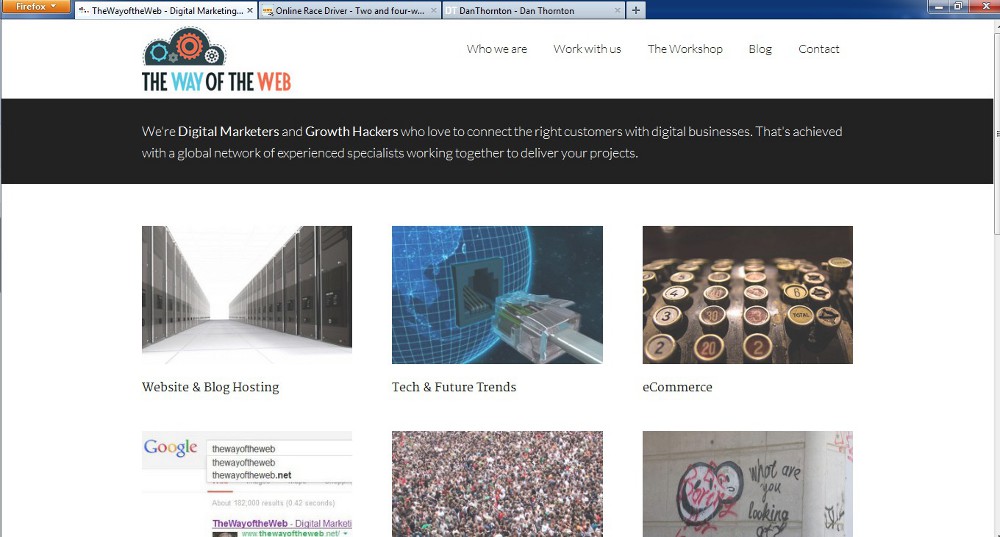
CreatingAFaviconExamples
Favicon examples from TheWayoftheWeb, OnlineRaceDriver.com and DanThornton.net

The good news is that any designer or developer should be aware of the need for a favicon. It’s certainly something we provide as a matter of course. It’s also relatively simple to create and upload for yourself if you are following a DIY approach or fancy making some changes.

Creating a favicon:

To generate your favicon you can either use any graphics or image editing software, or there are various online tools such as Faviconer.com, favicon.co.uk or Dynamic Drive.

We use either Photoshop, or the free, open source alternative, GIMP to create the image. Generally we start with a 64 x 64 pixel square to make it easier to edit and avoid issues when scaling down. Then when we’re happy, we’ll adjust the image size to 16 x 16 pixels.

It’s important to remember how small the favicon will be when displayed in a tab – in the case of this site, we considered that our logo was more important and recognisable than reworking the site logo to be bigger. The same held true for our gaming site OnlineRaceDriver.com, but I don’t have a logo for my personal blog, so I decided to pick my initials.

If you’re looking for inspiration, just take a look at what your favourite sites use.  When designing website assets for clients we’ll include the favicon as part of the package, along with website logos, social media images etc.

When you’re happy with your work, you just need to save the result as favicon.ico. (It’s listed in GIMP as ‘Microsoft Windows icon).

Uploading your Favicon:

Some CMS systems, such as Magento, allow you to upload your favicon directly. All you need to do is visit System > Configuration, and then look under General to find Design and the HTML Head section.

For WordPress various plugins exist to offer similar functionality, but it’s actually fairly easy to upload your new favicon yourself. That way you avoid adding extra software to your site, and having to download updates etc, for the sake of a task you might only ever do once every few years.

After creating a favicon.ico and saving it to your desktop you’ll need to login to your website hosting either via your website host and any FTP manager they provide, or via your own FTP Client (e.g. Filezilla).

First navigate to the Theme you’re currently using for your site, and when you can view all the related files, remove the existing favicon.ico file and upload your creation.

You can also upload an additional copy to the main directory of your site, e.g. https://thewayoftheweb.net/favicon.ico to ensure the icon also appears in RSS feedreaders and other locations.

Finally if you want to be compatible across some older internet browsers, you may also wish to edit the header of your page.

  • Go to your WordPress Administration Panel.
  • Click on Appearance.
  • Click on Theme Editor.
  • Select the file called Header or header.php to edit the file.
  • Search for the line of code that begins with <link rel=”shortcut icon” and ends with /favicon.ico” />. Overwrite it, if it exists, or add the following code below the <head> HTML tag.
    <link rel=”shortcut icon” href=”<?php echo get_stylesheet_directory_uri(); ?>/favicon.ico” />
  • Save the changes

And that’s it. When you’re making code changes, we’d recommend using a copy of the existing code and making sure you have a backup in the case of any problems.

You should start seeing your new favicon fairly quickly, although sometimes it can take some time to display due to various cache settings – generally more modern browsers are faster.

Creating categories and definitions by doing, not debating

March 3, 2012 By Dan Thornton

I just read a post by Peep Laja which talked about the old advice of inventing a new category to be able to charge more for your products than just slotting into a predefined definition, followed by a post by Neville Hobson on an attempt to redefine what PR means. And both have reinforced my belief that you only create new categories and redefine existing ones by actually going out and doing stuff.

As much as I can have respect for the people who get caught up in debates about what PR, Social Media Marketing, Content Marketing, Transmedia, SEO, etc all should mean exactly, the simple fact is that noone cares. Seth Godin talked about successful modern marketing beginning with product planning and development, but still many businesses and consumers see marketing as part of advertising.

When I try and define what I do for people, it comes out as:

  • I write for my own projects
  • I write for other people’s projects
  • I market my own projects
  • I market other people’s projects
  • I run training courses in writing and marketing
  • I run training courses in writing and marketing for other people
  • I provide research for my own projects
  • I provide research for other people
  • I host my own websites
  • I provide hosting for other people
  • I manage my own paid advertising campaigns
  • I manage paid advertising campaigns for other people
  • I manage affiliate campaigns for other people
  • Or I do: Writing, Journalism, Blogging, Natural SEO, Paid SEO, PPC, Content Marketing, Social Media Marketing, Training, Tutoring, Affiliate Management, Community Management, Analytics,

Either way, it means I should need the world’s biggest business cards. I don’t.

Dan Thornton business card - AKA TheWayoftheWeb.net and HotModMedia.com
It’s me. And a quick meeting or search tells you more…


But actually, what tends to happen is that my client list has grown from referrals from existing clients or from people finding out about me for one area of what I do, and those that are more rewarding for me in terms of enjoyment and financial rewards grow more quickly than areas that I might not favour, so over time my reputation in some areas will naturally build and lead to more focus.


Defining what you and your brand do:

Rather than worrying too much about an exact definition, it’s better to have an idea which you and any employees can broadly follow, but also be flexible within. I always loved the idea of my former employers at Absolute Radio, which was that we were ‘a digital entertainment company with audio at it’s core’, and targetted ‘reluctant adults’. That meant we always focused on sound and sound quality first, and always prioritised those people who were incredibly passionate about their interest (music, comedy, sport), but it didn’t matter whether we had an idea for a website, mobile app, radio station, or anything else, as long as it involved the best possible audio and delighted the right people. And in a challenging market for all broadcasters, it seems like they’re doing better than ever.

But noone ever tuned in because of those definitions – they tuned in because they liked what they heard as a result.

Too often I speak to companies who declare that ‘their customers don’t do it that way’ – and it turns out that actually it’s because they don’t allow customers to interact that way for some reason.

Or that customers ‘just don’t get what we’re trying to do’. Or that ‘clients just don’t understand’.


Building brands – do stuff, monitor, do more stuff:

You don’t build a brand simply by having logos or mission statements. Those are brand assets. What builds a brand is making stuff available, seeing how people respond and then building on it. Google didn’t define itself as a search engine, it set out to index the world’s information. Apple didn’t say it only made personal computers – it put design into technology, whether it’s a Mac, iPhone or iPad. The legendary production line methods of Ford went from one colour of car to over 1000 different variations for the Ford Transit van alone.

Geek Pride

Obviously to be successful, it’s not enough to be different – the recent demise of Saab is one example of how you can be known for being unusual but still fail due to not managing sales and costs effectively. But that name will still stand out for many years for a lot of people, and it’s easier to optimise a supply chain than to become known for brilliance and character.

Look at Amazon – offering web servers, books and Kindles. Artists such as Hugh McLeod, Tom Fishbourne, or Penny Arcade. Authors like William Gibson. Musicians from Robert Johnson to Hendrix to Skrillex. 37Signals and Wunderlist are as much about design as project management. I’m already incredibly excited about HiutDenim because I know Howies and The Do Lectures.

Put stuff out there and look at the response, using the wealth of data that is available and complimenting it with the right research.


Industries and reputations:

Some industries stuggle with their reputation. Obviously banks and bankers aren’t particularly well respected at the moment, and neither are journalists.

At the same time, SEO and Social Media ‘snake oil salesman’ has become a common criticism for digital marketing.

And yet I know brilliant journalists, SEOs and Social Media specialists who are incredibly well-respected and constantly in-demand because they do brilliant things consistently well. I’ve also had meetings with top marketing and SEO agencies which ended in disaster because they seemed to spend all their time talking a good game in public, but not delivering on it directly in a client meeting.

I actually have a couple of lists which are close to my heart – one is a list of companies I’d love to work with, whether as a freelancer or even possibly as a full-time employee because over the years I’ve known them, they always done things brilliantly (I also have a list of companies who seem to squander their potential and wish they’d let me help sort it out).

And I have another list of individuals I’d love to work with on a project at some point – it’s grown to quite a size over the years, with everyone from creative talents to hard-headed business people. And pretty much everyone on the list has worked on multiple projects, sometimes concurrently, but what they’ve done is always interesting or exciting or innovative or profitable – often all four.

The simple fact is that I don’t worry about crap definitions of the industries I nominally work in. And I’ve stopped worrying about being painted with the same brush as the snake oil salesman. If a million people see a great example of content marketing, or social media, or SEO that I’ve been involved in, then that’s far better mechanism for change than debating definitions.

I can haz new logo

February 15, 2012 By Dan Thornton

I’ve been running a personal blog for about 6 years, including early experiments on Blogger. Prior to that I’d had a simple homepage, along with some other static websites to play around with.

Over time I’ve managed to attract a reasonably large audience every month with a range of articles mainly covering writing and content, marketing, social media, SEO, and technology. But until 18 months ago, it was very much still a passion for my spare time, along with the videogame sites I’ve launched.

But after starting a freelance business, and with the ambition of growing, it was time to get things more organised – and about 18 months later I finally made use of a talented and friendly designer who was foolish enough to agree to provide a logo (I won’t say who as I don’t know if he’s accepting any more business at the moment).

So here it is, the logo for TheWayoftheWeb – your friendly content marketing, SEO and Social Media company.

It’s pretty simple, but I think it’s effective. Trying to come up with something to illustrate Content + Social Media + SEO was a challenge, particularly as I picked such a vague name years ago, and didn’t just want a name and strapline until I’ve done a bit more work on the exact proposition, as you could also have it as Writing/Content Marketing/Social Media/SEO/Training and a bit of Community Management/Affiliate Management as needed.

The Facebook Page and G+ pages already look massively improved. There’s still a bit of design work to do here, but I’m working on it. One of the great things about a self-hosted blog is that it forces me to actually get involved in the HTML and CSS myself on occasion, and I still feel smug when I manage to get something right first time without breaking everything!

What’s going to be interesting is seeing if there’s any increase in traffic/business to back up the horror designer friends have shown when I’ve launched and run sites without having a logo or branding in place first…

Misunderstanding cigarette branding…

November 22, 2010 By Dan Thornton

The UK Health Secretary, Andrew Lansley has suggested cigarettes should be sold in plain packaging, as ‘the evidence is clear that packaging helps to recruit smokers’.

Sadly for those who want to prevent smoking, he appears to be talking cobblers – as suggested by the fact the previous Government ditched the same plan two years ago due to a lack of evidence to that effect.

What’s happened is that there’s a misunderstanding of the role of branding in cigarette smokers.

  • People encourage other people to start smoking.
  • Branding and People influence which particular product someone smokes.

Removing branding won’t make any difference to the amount of people trying smoking. It might make a difference in the number of cigarette companies, but the spread of cigarette smoking is largely spread by encountering other people that smoke and being influenced by them in some way. There’s a handy chapter in The Tipping Point on the triggers for smoking, quoting examples of being influenced by people who were seen as cool, and also smoked. The basic hypothesis is that some people who smoke happen to be cool, and therefore smoking is perceived as cool (Rather than smoking making someone cool – the reality is that it makes people smell of tobacco, wheeze when they’re running, and end up dying earlier more often than if they hadn’t smoked – but as a smoker for over 10 years, I already know this).

So why do tobacco companies spend so much on marketing, and finding ways to place their brands in your eye, despite cigarette advertising bans?

The first cigarette I ever tried was a Silk Cut Ultra Light – and yet for 10 years I’ve smoked Marlboro. I’m not sure it’s a coincidence that Ayrton Senna drove a Marlboro McLaren, Wayne Rainey rode a Marlboro Yamaha, and I actually suffered through the feature film ‘Harley-Davidson and the Marlboro Man‘. Given the choice, I’ll pay a slight premium for the familiar taste and amount of nicotine, plus the branding and image etc. But if that brand vanished tomorrow, I’d find another one in the time it took to run out of cigarettes. The fact is that in the past I’ve bought John Player Specials (JPS Lotus, JPS Norton), and Rothmans (Rothman Honda in the Wayne Gardner era) as fall-backs which have no relation in taste or nicotine levels.

Wayne Rainey driving out of turn 3 at the 1990...
Image via Wikipedia

I’d reveal a more effective way to tackle smoking, but unfortunately there’s a limit to how long I can write about the topic without nipping outside for a cigarette…

Do UK businesses really value Twitter?

December 11, 2009 By Dan Thornton

Techcrunch recently picked up on a poll by Accredited Supplier of 1200 UK businesses who are currently using Twitter, and echoed the findings that ‘UK Business bullish in Twitter’.

Besides the caveat that the UK businesses that are so bullish are the ones that are actually already using it, there’s a little bit of interesting info in it.

Apparently 62% of UK businesses are using Twitter purely as a branding exercise, with 33% combining branding and sales, and 15% using it purely for sales (They might want to take a look at Dell making millions on Twitter for starters).

But then it goes on to reveal that just 14% of the businesses are tweeting daily, and 21% weekly. Which leaves 65% posting a monthly message or less – should that even count as a business using Twitter?

So there’s no surprise that 84% don’t think they’ve achieved a return on investment so far – but strangely more businesses would be willing to pay for ‘additional business functionality’ at 22%, than have actually claimed a return on investment (16%).

So maybe a better headline and summary would be that UK businesses are still mightily confused when it comes to Twitter. Some of them want more functionality despite not seeing any returns, and many of them claim they’re using it when they might log in less than 12 times a year.

They haven’t so much missed the point as built a dual carriageway bypass around it.

If you’re starting to use Twitter on behalf of your business, you need to have a quick think about what it is you’re looking to achieve and how it benefits your business – getting messages out there is somewhat useful in itself, but generally it’s expected that you might look at the rate of acquisition from a source, and the investment of resource it’s taken, and then weigh that against other sources of visitors/buyers/purchases.

Then you can not only determine the true level of ROI, but also potentially justify actually engaging on a regular basis and utilising Twitter as both a customer acquisition channel – but also as a customer retention channel. While new customers are great, it’s more cost effective to retain a current customer by increasing loyalty – and although you might need to interact and ask questions on at least a weekly basis, the amount of loyalty and customer service you can action can be measured as a definite return.

I suspect you could perform the same poll with most of the common tools – email, Facebook, Myspace etc, and you’d probably get similar results, because the same people have signed up without a plan after seeing the buzz, dabbled a little, and have no idea what they’re doing next.

Which means that there are big opportunities if you’re reading blogs like this, using Twitter on a regular basis and developing or following a clear plan with a decent amount of ROI.

  • Page 1
  • Page 2
  • Go to Next Page »

Primary Sidebar

Join us…

  • Facebook
  • Instagram
  • LinkedIn
  • RSS
  • Twitter

We only exist to deliver results for your business. So you get fresh Content, expert SEO, engaging Social Media, or a new Website which is right for you – and your customers.

We help you build your brand, reach more customers and increase your revenue

Search

Categories

Creative Commons License
This work by TheWayoftheWeb is provided under a Creative Commons Attribution-NonCommercial-ShareAlike 4.0 International License.

Start growing your business today Contact Us

TheWayoftheWeb

Copyright © 2026· TheWayoftheWeb Ltd. Company Number 08038527. ICO registration: ZB397650